Office of the City Auditor

Alexander Marion is the elected Syracuse city auditor.

Welcome to the Website for the Syracuse City Auditor.

Here, you can find more information about our mission, the work we do, and how you can get in touch with us. Thanks!

Alex!


City Auditor Seal

Alexander Marion, MPA

City Auditor


Screenshot 2025-12-15 122044.png

CNY Central: Syracuse snow plow operators unlicensed, companies begin filing paperwork

December 10, 2025

Read the full article here 


Screenshot 2025-12-15 113316.png

WAER: City Auditor: Most private snowplows in Syracuse don't have licenses

December 2, 2025

Read the full article here


Screenshot 2025-12-15 102637.png

Spectrum News 1:Syracuse private snowplow contractors need a license to operate; city auditor says non have been issued so far this year

December 2, 2025

Read the full article here


2025 Year In Review

Revisiting the Work of the Syracuse City Auditor's Office in 2025

During 2025, the Office of the City Auditor released three audits and completed a further five reports. From the Rental Registry to Claims Processing, Property Fires to Federal Funding, our work this year has delivered detailed and well-researched reporting on impactful issues facing the City of Syracuse.

In this Year in Review, you’ll find summaries of each of our reports and audits, along with the recommendations made to address findings identified. This review also shows how our Office has delivered advancing our recommendations and uses collaborative public engagement as a tool to improve and advocate for our community.  


Verifying Vouchers(PDF, 44MB)

Verifying Vouchers

At Audit of Claims Processing

Auditor Marion's third audit of 2025 investigated City payment processing to ensure payments were properly authorized, supported, and being made in a timely manner.

The audit found that policy manuals and procedures were not uniformly applied and a lack of segregation of duties presented a serious internal control concern. The audit revealed violations of the city's travel and purchase card policies, payments made without adequate support, and poor asset tracking by city departments leading to payments being made for equipment without fully understanding the location or use. 40% of city payments were paid late, with a bottleneck in the city's Help Desk a significant factor in late payments. 

Auditor Marion recommended a series of recommendations to tighten policies and safeguard finances, led by the recommendation to amend the City Charter and move the claims examination function to the Department of Audit where its independent and elected City Auditor can provide objective oversight.  The Auditor also recommends more training for staff, more standardization in the process, and increased scrutiny when reviewing invoices.     


Cover Picture.png

Service on the Sidewalk

Compliance Audit of the City of Syracuse Sidewalk Cafe Permit Ordinance

City Auditor Alexander Marion's latest audit reviews the Sidewalk Cafe Permit and tests compliance with the program by both City staff and local businesses. The Ordinance, established in 2014, requires businesses seeking to use City sidewalk for service customers to get a permit, provide necessary insurance and follow safety and accessibility rules. 

The audit found the permit to be necessary to protect the City against lawsuits but noted it only generates about $4,000 in annual revenue. Multiple departments, including Police, Fire, and DPW help review applications, but no department is enforcing the rules. The review process is allowing the issuance of permits to businesses which do not have valid Certificates of Use, often for outstanding fire safety issues. The enforcement process was found to be non-existent and nearly two dozen businesses were found to be operating cafes without a permit, including many who have a liquor license and are required to notify the State about their outdoor seating. 

The audit recommends overhauling the permit to discern between small daytime cafes, evening bars, and late-night clubs, and to charge a higher rate for businesses which sell alcohol. The Auditor also recommend shutting down all businesses which don't have valid Certificates of Use and enforcing Right-of-Way Ordinances, including completing mandatory inspections of Sidewalk Cafes. 


Following The Fire Cover Photo.png(PDF, 10MB)

Following The Fire

Analysis of 2024 Vacant Structure Fires

Following The Fire is City Auditor Alexander Marion's latest report which investigates vacant structure fires across the City of Syracuse in 2024. Of the 87 structure fires put out by the Syracuse Fire Department in 2024, 25 of them (29%) were found to be in vacant structures. This in-depth report is the result of months of work reviewing police and fire reports, code enforcement records, tax, water, and legal records, and building permits and registrations to understand what lead up to these fires, what has happened to the properties since, and what the City can do prevent structures like these from becoming the next victims of a fire. 

The data reveals common themes - these properties often had open code violations, many had faced legal action from the City's Bureau of Administrative Adjudication, and most their water service shut off. Many others were delinquent on water charges, property taxes, or both, and geographically, these fires were centered in some of the City's most impoverished neighborhoods. 

The Auditor's report recommends developing an early warning system to alert City officials to potential problem properties so they may stage early interventions. The City should also update local laws to require all vacant structures to register with the Vacant Property Registry; the board up procedure should also be overhauled and the City should adopt FEMA's "Board and Brace" method which provides more security at these properties. The Syracuse Fire Department should also reduce their risk and make spotting dangerous houses easier by adopting FEMA's "Red X" markings for vacant properties. City Code Enforcement can and should perform more aggressive inspections and the Common Council should ensure funds are available to professionalize the department by requiring uniforms, body cameras, and City-issued vehicles to perform their job.   


Budget-Balancing-Act-Cover-Picture.png(PDF, 6MB)

Budget Balancing Act

Analysis of the FY 2025-26 Mayor's Recommended Budget Estimate

An analysis of Mayor Walsh's proposed budget for FY26, Budget Balancing Act outlines the City's budget process and timeline, presents findings and recommendations on the proposed budget, and provides an update on the recommendations made by the City Auditor in "Making Dollars and Sense," his review of the FY26 enacted budget. 


The report notes several new revenue sources appear in this year's budget including school zone and school bus arm violation revenue, along with hotel room occupancy taxes. Despite new revenues, City expenses are covered in part through the $27.2 million use of fund balance and a property tax hike of 2%.  


The City Auditor recommends providing the available fund balance as part of the City's budget documents like Onondaga County does. The City should also limit borrowing and prioritize only essential bonding until interest rates come down. The Auditor also recommends departments clearly outline their employees who are paid by the Syracuse Urban Renewal Agency (SURA).


In addition to the report, the City Auditor has also created a digital spreadsheet version of the budget, along with five years of actual expenses. This document compiles data from past City budgets and is meant to be a tool for the public and policy makers as they consider this year's proposed budget. 


24-25 Annual Report Cover Photo.png(PDF, 3MB)

2024-25 Annual Report

Reviewing the Work of the City of Syracuse Department of Audit

The 2024-25 Department of Audit Annual Report has been submitted to Mayor Ben Walsh in accordance with Section 5-104(5) of the Charter of the City of Syracuse - 1960, as amended. This year's report provides a look back at last year’s achievements, highlights the Department of Audit's work over the past twelve months, and lays out the Office's priorities for the coming year. 


Living-Wage-Cover.png(PDF, 61MB)

Working For A Living Wage

An Audit of the Syracuse Living Wage Ordinance

The second comprehensive audit by City Auditor Alexander Marion, "Working For A Living Wage" examines the Syracuse Living Wage Ordinance, first adopted in 2005, and investigates how well the City and its contractors are complying with the law.

The report finds that all contractors are exempt from the law as various exemptions, exclusions, and carveouts have effectively disqualified all vendors for some reason or another. As a result, some contractors were able to pay a rate below the living wage without consequence. The City earns low marks for failing to establish the required policies and procedures for handling complaints and violations. City officials also failed to provide contractors with updated rates and awarded a lucrative contract to a City employee.

To improve the ordinance and compliance with the law, Auditor Marion makes four recommendations, including overhauling the ordinance and changing the living wage rate calculation formula, two steps which will increase the number of people receiving a living wage and the amount they earn. The Auditor also call for the City to update procurement policies and ensure all City employees are paid a fair, living wage.     


Runaway Rentals(PDF, 3MB)

Runaway Rentals
Analysis of the Enforcement and Effectiveness of Syracuse's Rental Registry

Runaway Rentals is a review of the Syracuse Rental Registry by City Auditor Alexander Marion. The report examines the origins of rental registries across the county and in New York State and discusses the basics of Syracuse's program and how it was enacted. The report dives into the properties required to register and discusses factors considered in determining participation. It also looks at compliance, budget projections and activity indicators, and violations of the law. 

The report finds the program has a compliance rate of just 33% with thousands of properties not complying despite being required to have certificates. Revenue for the program also consistently fails to hit budgeted amounts, falling short by hundreds of thousands of dollars, creating significant budget gaps. City law also needs updates to reflect current housing priorities, and the Rental Registry fee schedule needs to be adjusted for inflation.

The City Auditor makes 13 recommendations to improve the program, increase compliance, and better use revenues generated by fines and penalties. City law should be changed to ensure lead fixtures at rental properties are removed and lead piping is disclosed to tenants before signing a lease. The Rental Registry fee schedule should also be amended to increase fines for non-compliance and allow for a revocation of a rental registry certificate. Fines and penalties from the rental registry should also be earmarked to support City housing priorities, including providing resources to relocate residents forced from unfit homes. City officials can also do more to increase proactive inspections and should improve outreach to landlords including creating an educational seminar about the program. As an additional step, the Division of Code Enforcement should create and distribute a list of compliant landlords who are following the law. And finally, City homeowners are encouraged to make sure they are receiving STAR property tax rebate credits on their primary property which could save them hundreds of dollars a year.


Consequences of Change(PDF, 15MB)

Consequences of Change

Impact of a Changing Federal Landscape on the City of Syracuse

Consequences of Change is City Auditor Alexander Marion's first report of 2025, highlighting federal funding to the City of Syracuse and the impact it has on city operations, community organizations, and the Syracuse City School District.

The report finds the City is the recipient of millions of dollars in federal funding annually, and recently has benefited from a significant federal investment as part of the Route I-81 redevelopment project. Federal dollars have helped support police and fire department initiatives, numerous community groups through Community Development Block Grant (CDBG) funding, and federal tax credit programs including the Low-Income Housing Tax Credit (LIHTC) have supported dozens of affordable housing developments across the City. Federal support also helps fund countless programs at the Syracuse City School District, including millions of dollars to help ensure our students receive nutritious meals. 

The report recommends the City directly advocate for federal funding in the coming years as a change in administration and a new Congress take control in Washington. The City should also prepare an annual report which summarizes the federal funding received and how those funds were used. Additionally, Congress should expand the LIHTC program to make more tax credits available to states to assist with much needed affordable housing development.


YIR screenshot .png(PDF, 6MB)

2024 Year In Review

Revisiting the Work of the Office of the Syracuse City Auditor in 2024

The 2024 Year In Review summarizes the work of the Office of the City Auditor over the past year, recapping the audits and reports the office has completed and highlighting the recommendations which were suggested.   


Rethinking Retirement Cover Picture.png

Rethinking Retirement 

Analysis of the Impact of Pension and Employee Benefit Costs on Syracuse

Rethinking Retirement is City Auditor Alexander Marion's 9th report of 2024 which enamines the New York State and Local Retirement System (NYSLRS) and the impact rising pension contributions and other employee benefit costs have on Syracuse and cities across New York. The report also provides resources for employees who want to learn more about their pension status.

The report finds some City employees are uncertain of their retirement status, especially provisional appointees, who are often waiting for civil service tests to be administered. Unless they opt in, these employees lose out on valuable years of service credit which can lower their future pension benefits. We also learn that City government spent more than $200 million in employee salaries and benefits in FY24 and is on track to pay more than $35 million in employee pension contributions to New York State this year - an increase of over 36% in just four years. Those costs will continue to rise and an expected to cost the city more than $50 million annually by 2030.

A series of recommendations are proposed which may be helpful to City operations, employees, and state leaders. The City should begin cost allocating benefit costs to departments to show the true cost of running city operations. They should hold an annual retirement and benefits training course to ensure employees have the latest updates about these programs. The City Auditor recommends all employees opt in for the retirement system at hire and to create an account with the State Comptroller's Retirement Online program to check their retirement status and make changes. For state leaders, legislators should consider easing the burden on local governments by covering all or a portion of employer contribution costs. 


Incomplete Streets picture.png

Incomplete Streets 

An Updated Analysis of the City's 2012 Bike Plan and Ongoing Improvements to Bicycle Infrastructure and Safety

Incomplete Streets is City Auditor Alexander Marion's latest report which provides an analysis of the City's Bicycle Plan and ongoing improvements to bicycle safety and infrastructure. The report examines the status of bicycle-related capital improvement projects and reviews the implementation of the Syracuse Bicycle Plan, part of the City of Syracuse Comprehensive Plan.

The report finds that just 11% of projects in the Bike Plan are completed more than a decade after its adoption. Too much emphasis on infrastructure is on striping excess roadways space and not enough attention has been given to ensure these spaces are painted green. We learn laws governing bicycles have not kept up with the increase in infrastructure or the proliferation of new e-bikes and scooters. Capital improvement projects often lack specific details of work to be performed and too many projects are not completed within a year, costing City residents interest on funds not being used. A surprising finding that reported bicycle thefts are up over 400% so far in 2024 was particularly alarming.

The report makes a series of recommendations which will make cycling safer and more predictable and ensure good value for the City taxpayer. The City should update the Syracuse Bike Plan, increase painting of bicycle facilities, and ensure City departments and contractors restore roadways following construction work. City code needs updating to reflect the increase in ridership and a “blocking a bicycle lane” violation should be created. The City should also revisit their bike-sharing agreement with Veo and make improvements to improve safety and equity and ensure City taxpayers are getting good value.


There No Place Like Home.png

There's No Place Like Home 

Impact of Good Cause Eviction Protections on Syracuse Tenants

"There's No Place Like Home" is City Auditor Alexander Marion's 8th report of 2024, examining how Good Cause Eviction protections would impact tenants in Syracuse. Good Cause Eviction legislation has developed out of the increasing housing crisis in New York State, and across the nation. In Syracuse, more than 60% of residents rent their homes. The report identifies the basic principles of Good Cause Eviction and addresses some common misconceptions about the law; it also outlines the decisions municipalities must make in setting forth their own good cause protections.

The report finds Syracuse has high rates of evictions contributing to higher levels of homelessness. In 2023, more than 2,100 eviction warrants were filed in City of Syracuse court, and Central New York has seen a 63% increase in homelessness since 2019, with a staggering 192% increase in family homelessness during that time. 45% of people currently experiencing homelessness were previously living in a place where an eviction lawsuit was brought against that person or the lease holder. The report also finds that many housing units are owned by LLCs and that LLCs may be used a tool to avoid the tenant protections of Good Cause Eviction. 

The report issues five recommendations, chief among them, is for the City of Syracuse to implement a Good Cause Eviction law and set the unit threshold at one unit, and the affordability threshold at 345%. The City Auditor also recommends changes to local and state law including asking New York State to pursue a statewide Housing Access Voucher Program and a tenant right-to-counsel program, in addition to stripping real estate brokers and other licensed professionals of their credential if they have excess code violations at their properties. At the City level, the City should pass an LLC Transparency Act and require LLCs to reveal beneficial owners for governmental purposes, such as the rental registry, water bills, property taxes, and business licenses.
 

Sworn to protect image.png(PDF, 8MB)

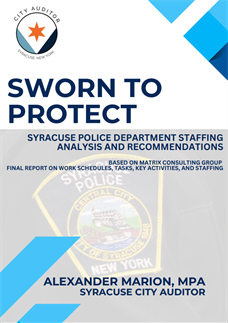
Sworn To Protect

Syracuse Police Department Staffing Analysis and Recommendations

"Sworn to Protect" is the latest report from City Auditor Alexander Marion which investigates staffing and scheduling at the Syracuse Police Department (SPD). The report was undertaken at the request of the Syracuse Common Council, and is based on the final report on SPD tasks, key activities, staffing, and scheduling from Matrix Consulting Group (Matrix) who was contracted to perform an assessment of staffing, operations, and response capabilities of the department. 

Matrix's report is written for a "law enforcement audience" and thoroughly outlines the structure of the department, analyzes their operations, and makes 87 recommendations which are shown by the natural divisions of labor at SPD. These recommendations cover topics including recruitment, training, continuing education, reporting, supervision, scheduling, systems, and more. 

The City Auditor's companion report categorizes the Matrix recommendations into easier-to-understand topics to allow readers to gain a better understanding of the types of recommendations being made. These topics include: Civilian Assignments & Civilianization, Reporting & Public Information, Planning, Training, & Professional Development, and Coordination with Others. The report also makes ten key recommendations which the City Auditor believes will lead to greater transparency, faster and more professional service delivery, higher levels of accountability, and cost savings. 


LP pic.png

A License May Be Required

Audit of the City of Syracuse License & Permit Operations

"A License May Be Required" is the first full audit released by City Auditor Alexander Marion, and is a regular requirement of the City Charter. In this audit, the first on city licensing since 2010, the Auditor investigates the history of licensing in Syracuse and finds decades of legislation has resulted in confusing, outdated, and overlapping rules; to complicate matters more, license information is difficult to locate online and offices are hard to find in person. 

The audit also finds licensing functions to be poorly enforced with insufficient staff to ensure compliance with the law; some licenses, including those for commercial waste haulers, have been discontinued due to lack of enforcement. The report also highlights concerns about the financial aspects of licensing. Licensing revenue is down more $100,000 (more than 80%) over the past decade and there are shortcomings in the City's policies for the collection, safekeeping, transit, and reconciliations of payments collected outside of City Hall.

To improve the organization, operations, and financials of this vital City function, Auditor Marion calls for the creation of a new Department of Permits, Licenses, and Inspections to be located at City Hall, creating a true one-stop shop for all City services. The Auditor recommends the City conduct a comprehensive review of all licenses to re-prioritize the permissions needed to meet the goals of a modern city.  The City should also improve policies related to cash handling and reconciliations and ensure financial transactions have adequate supporting documentation. 


Making dollars and sense pic.png(PDF, 4MB)

Making Dollars and Sense

Analysis of the FY 2024-26 Enacted Syracuse City Budget

In Making Dollars and Sense, the Office of the City Auditor examines the FY25 City of Syracuse Budget and investigates the revenue and expense drivers for the City. In the analysis, we learn that sales taxes, state aid, and the property tax levy make up about 80% of all city revenue. Federal assistance through the American Rescue Plan Act (ARPA) – a non-recurring revenue – is the 5th largest revenue source. Police and Fire spending lead the expenses with combined budgets of nearly $110M and medical insurance and mandatory payments to state retirement systems will cost the city nearly $79M next year.  A rising concern is debt service payments with the FY25 budget showing a 36% increase in payments to cover principal and interest on city bonds.

The report recommends departments do a better job showing their expenses by divisions of labor, and departments should provide an organizational chart each year to show of their department is organized. Budgets should include high-quality activity indicators which are true measures of the department's work. Budget documents should list contracts and ongoing obligations to help better understand departmental spending. The Common Council can improve public participation by hosting more public hearings, including holding them in every council district and varying their start times; in 2025 and beyond, the Council should also begin hosting a virtual public hearing.
 

Roadwork Ahead(PDF, 23MB)

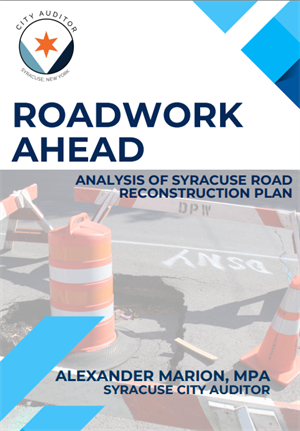
Roadwork Ahead

Analysis of Syracuse Road Reconstruction Plan

Roadwork Ahead investigates street repair in Syracuse and looks to understand how the City selects the streets it paves each year. The report finds that City officials can do more to increase communication and cooperation with outside partners like the Syracuse Metropolitan Transportation Council (SMTC), and internally between departments. The report also identifies inequities in charges for routine City services like Slurry Seal and Street Sweeping. The City Auditor makes recommendations to improve collaboration and more equitably charge city ratepayers for the services they receive. The Auditor also recommends new rules to hold contractors who dig in our streets accountable for their work.


2024 Annual Report(PDF, 7MB)

2024 Annual Report

In accordance with the City Charter of the City of Syracuse, all departments heads are required to file an annual report by the end of March each year. The City Auditor's Annual Report outlines the work the office has done over the past year and it includes its audit plan and planned work for the year ahead. 


Park-At-Your-Own-Risk-Cover.jpg(PDF, 7MB)

Park at Your Own Risk

Analysis of 2023 City of Syracuse Parking Violations

Park at Your Own Risk investigates the City of Syracuse Traffic Code and analyzes the parking violations issued by the City in 2023. The report finds City parking operations are fragmented and Pay to Park hours and zones are not enforced equitably. The City Auditor makes recommendations including creating a new centralized Department of Parking and Mobility, establishing a new "Blocking a Bicycle Lane" violation, increasing fines for violations which impact public safety and accessibility, and updating parking signage.


AIM-Higher-Pic.jpg(PDF, 3MB)

AIM Higher

Analysis of the Impact of New York State AIM Funding on the City of Syracuse

AIM Higher investigates the history of New York State revenue sharing and specifically looks at the Aid and Incentives for Municipalities (AIM) Program which has been the primary revenue sharing program since 2005. AIM funding to local municipalities has been frozen for more than a decade, depriving cities, towns, and villages of critical funding needed to offset increasing operating costs.   

Please visit our Archives page for past audits and report.

2025 City of Syracuse Budget Workbook 

The 2025 City of Syracuse Budget Workbook is created by the Office of the City Auditor as a resource for the public and policy makers. 

The information in this document is derived from past City budget documents, available at: https://www.syr.gov/Departments/Budget/City-Budget. The data in the Workbook includes prior year actuals from FY20 through FY24, along with the current year (FY25) Budget and Estimate, and the FY26 Proposed Budget.

Some figures may appear inconsistent with numbers provided in the budget book due to rounding and other mathematical errors. 

Any errors, omissions, and corrections should be directed to the Office of the City Auditor. Please contact us at (315) 448-8477 or audit@syr.gov.

As updated are made, our office will release new versions of this document.

Click Here To Download the 2025 Budget Workbook.(XLSX, 770KB)

Version 1, Date: April 22, 2025