Vision Zero Initiative

Screenshot-2023-10-30-185258.png

Vision Zero is a commitment to eliminate death and serious injuries from traffic crashes. Many communities across the U.S. have completed or are working on safety action plans that align with Vision Zero. In 2025, Syracuse joined the ranks of these communities by adopting our City of Syracuse Vision Zero Action Plan.

The Vision Zero Action Plan (VZAP):

  • Identifies where and why severe crashes occur, including identification of a High Injury Network.
  • Sets a data-driven course of action to reduce traffic fatalities and serious injuries by 35% by 2035, and to eliminate these severe crashes entirely by 2055.
  • Identifies actions to achieve these goals organized around three themes:
    • Slow vehicle speeds
    • Design safe streets for people walking, rolling, and biking
    • Promote a culture of safety

Implementing Vision Zero involves many City departments and community partners. The Vision Zero effort is being led by the Department of Public Works, working closely with the Department of Engineering, Public Safety, Division of City Planning and Sustainability, Common Council, and the Mayor’s Office, plus community partners such as the Syracuse Metropolitan Transportation Council (SMTC). A Vision Zero Advisory Group will be established to help guide implementation of the Action Plan. 

Why do we need Vision Zero in Syracuse?

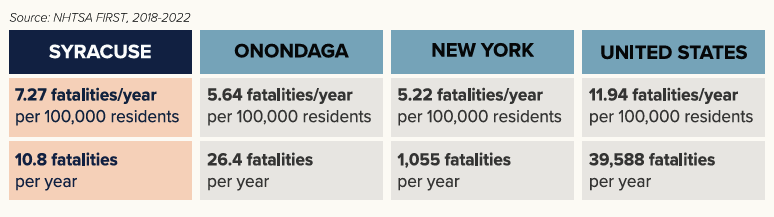
In the last five years, between 2019 and 2023, 42 people lost their lives in traffic crashes on surface streets in Syracuse, another 608 people were seriously injured. All told, the lives of 130 people on average are forever altered in crashes every year. These preventable tragedies affect people, families, communities, and our city.  

Since 2007, average traffic deaths in Syracuse have increased 34%. The number of people killed in traffic crashes is rising faster in Syracuse than in Onondaga County, the State of New York, and the nation as a whole.  

Some people bear the burden of traffic deaths and serious injuries more than others. People walking, rolling, and biking accounted for 46% of fatal crashes in the last five years and 29% of all fatal and serious injury crashes in the last five years. Black, Indigenous, and people of color in Syracuse experienced a per capita traffic fatality rate over twice that of people who identify as white alone and non-Hispanic/Latino. 
Vision Zero Infographic 1.png

What is Syracuse doing to achieve Vision Zero?

The Vision Zero Action Plan was completed in May 2025 and approved by the Common Council in October 2025. The Department of Public Works, including a new Vision Zero Coordinator, is working to implement the Action Plan. Over the next year, this will include outreach to community groups and creation of a Vision Zero Advisory Group. We will also work towards establishing a “quick build” program of improvements and seek funding for future capital projects.

The Department of Public Works is also continuing existing programs that support the Vision Zero Action Plan including the Municipal Sidewalk ProgramSpeed Hump Pilot Program, and Bicycle Infrastructure.

In 2025, the City implemented three traffic safety camera programs: school zone speed cameras, red light cameras, and school bus stop arm cameras. We are beginning to receive and evaluate data from these programs. 


Where can I learn more about Vision Zero?

The Vision Zero Network provides resources and case studies to illustrate the benefits of Vision Zero and provides best practices to eliminate traffic deaths and serious injuries.  

The United States Department of Transportation has adopted and is implementing the National Roadway Safety Strategy, which has a Vision Zero goal. 

Vision Zero actions are based on the Safe System approach, which utilizes many layers to prevent crashes and reduce harm. The Safe System approach accepts that humans are vulnerable and that we make mistakes, but redundancies in how we design roads, vehicles, and emergency response systems can mitigate those risks.

New York State has adopted a “Towards Zero Deaths” vision and follows the Safe System approach in their most recent Strategic Highway Safety Plan